

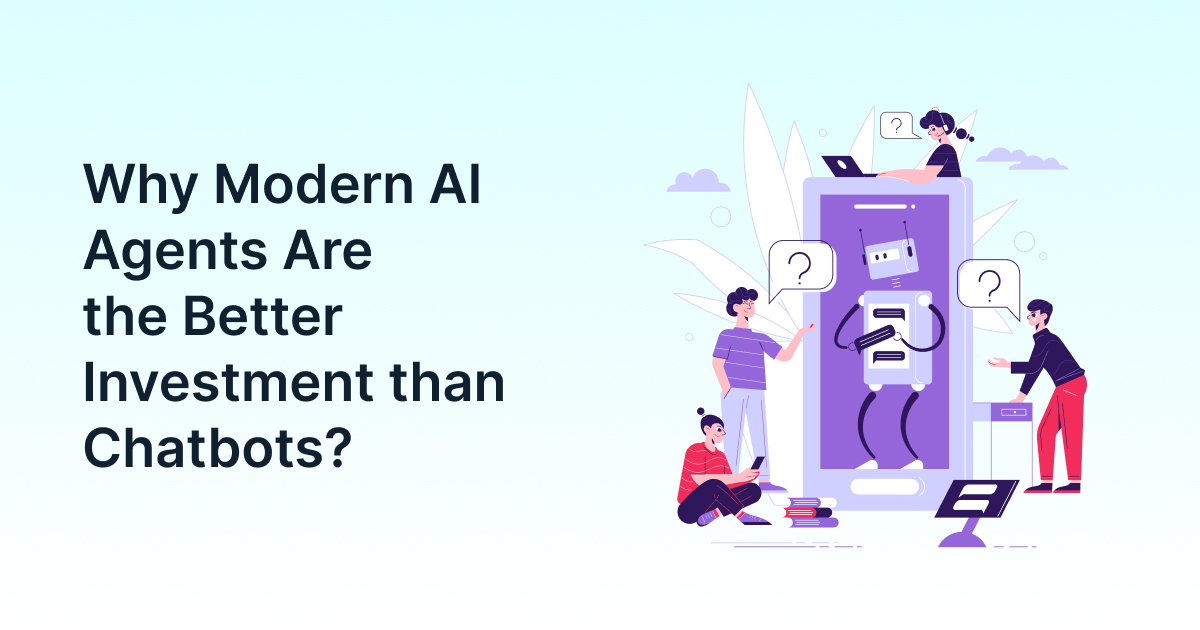
If we are being completely honest with ourselves, we can agree that we all have been trapped in that infinite, agonizing loop of “I didn’t quite catch that. Would you like to return to the main menu?”
Legacy chatbots were a great stepping stone back in the day. But let’s face it, they are essentially glorified decision trees wearing an AI mask. They frustrate your customers, exhaust your internal support staff, and leak revenue every single hour they remain online.
As we are halfway through 2026, forward-thinking enterprises are rapidly executing a legacy chatbot replacement strategy. The reason is simple. The era of static, click-based chat is officially over. Today, the choice between AI agents vs chatbots is the defining line between businesses that scale effortlessly and those that sink under heavy operational drag.
If you are looking to elevate your digital ecosystem, upgrading enterprise customer service with AI agents is no longer just an optional tech upgrade. It is an absolute, non-negotiable operational necessity.
At Panaceatek, we help businesses cut through this digital noise. We blend years of expertise in advanced software development, artificial intelligence, and complex digital integration to help you build smart systems that actually solve real-world problems. Let’s break down exactly why modern, autonomous AI agents are the ultimate high-yield investment your business needs right now.
Agentic AI at a Glance
- Beyond Scripts: Unlike static bots, autonomous AI agents understand context, make decisions, and execute multi-step workflows.
- Radical Efficiency: Upgrading enterprise customer service with AI agents slashes operational costs by automating end-to-end tasks instead of just deflecting tickets.
- True Business Integration: Agents securely connect with your ERP, CRM, CMS, and logistics engines to actually do the heavy lifting for your business.
- Unmatched Scalability: Shift your human staff from repetitive troubleshooting to high-value strategic work, driving massive, measurable ROI.
AI Agents vs Chatbots in 2026
To understand the core difference between static chatbots and autonomous AI agents, look at what happens behind the scenes. It’s quite similar to the custom AI agents vs off-the-shelf solutions debate. Chatbots are purely reactive; they wait for a specific trigger and match it to a pre-written response. AI agents, on the other hand, are proactive problem-solvers that can plan, reason, and act.
| Feature / Capability | Legacy Chatbots | Autonomous AI Agents |
| Operational Core | Rules-based, hardcoded decision trees | LLM-powered neural reasoning and planning |
| System Integration | Surface-level APIs (read-only) | Deep read/write actions across enterprise databases |
| Workflow Scope | Single turn, question-and-answer | Multi-step autonomous task execution |
| Problem Solving | Rigid menus; fails outside predetermined scripts | Handles unstructured, ambiguous requests with ease |
| Real ROI Impact | Minor deflection; high human escalation rate | Drastic reduction in human touchpoints |
Is Your Business Outgrowing Its Conversational AI?
Are you still relying on hardcoded scripts to handle dynamic human interactions? When we analyze the conversational AI evolution, it is easy to see how the market shifted. Legacy chatbots require constant, manual rule updates to keep functioning. That means your engineering team spends countless hours writing code just to patch up conversational dead-ends.
What is legacy chatbot replacement?
It is the process of swapping out old, rules-bound chat interfaces for dynamic systems. These newer platforms handle complex user intents without breaking.
Why do static systems fail?
They lack memory, fail to grasp real context, and require manual maintenance. This frustrates your users and drives up your support costs.
What makes the conversational AI evolution different?
Modern systems do not just talk; they adapt, learn, and execute workflows. They turn a simple conversation into an active transaction engine.

Why Do Legacy Chatbots Fall Short for Modern Enterprise Needs?
Are static bots actually hurting your customer loyalty and operational workflow? The answer is a definitive yes. Legacy chatbots fail because they cannot adapt to the unstructured ways that real people naturally communicate. When a customer interaction deviates even slightly from a pre-programmed script, the legacy system breaks down entirely.
What is the difference between static chatbots and autonomous AI agents?
Static chatbots are strictly bound by rules, templates, and pre-written scripts. Autonomous AI agents utilize live reasoning to understand intent, make independent decisions, and carry out tasks.
Why do rigid interfaces frustrate users?
Because real humans do not speak in rigid, pre-determined menu options. When forced into restricted boxes, customers abandon the chat frustrated.
How does maintenance drain your budget?
Every time your business updates a product, policy, or service, engineers must manually rebuild the chatbot’s decision trees. That represents a massive waste of precious IT resources.
- High human escalation rates: Traditional bots only deflect basic queries, leaving your team to clean up the complex cases.
- Fragmented data silos: Old bots cannot securely talk to your backend systems, limiting them to surface-level FAQs.
- Brand reputation damage: A clunky chatbot experience directly reflects on your brand’s technical capability.
How Autonomous AI Agents Drive Better Business ROI?
To measure the ROI of generative AI projects, you must learn one thing. Can an AI system pay for itself while actively generating new business value? Absolutely, and the financial data backing this up is undeniable. When you deploy autonomous AI agents, you are not just buying a chat tool; you are hiring a tireless digital workforce. These systems do not sleep, do not lose their patience, and execute actions with mathematical precision.
Why are modern AI agents a better investment than chatbots?
Because agents handle entire operational workflows independently instead of merely directing users to help documents. This turns your support center from a cost sink into a highly efficient value engine.
How do agents lower support costs?
By resolving complex issues, like processing refunds or updating shipping details, completely on their own. This dramatically reduces the need for human touchpoints.
Where does real scalability come from?
Your human experts can step away from repetitive triage and focus entirely on high-value projects. This boosts both team morale and your overall operational throughput.
| According to, Gartner, Agentic AI has emerged as a revolution for customer service, paving the way for autonomous and low-effort customer experiences. Unlike traditional GenAI tools that simply assist users with information, agentic AI will proactively resolve service requests on behalf of customers, marking a new era in customer engagement. |

Key Features to Look for in a Modern AI Agent Solution?
How do you choose an AI platform that is a clear win in AI agents vs chatbots discussion. An enterprise-ready AI agent must be secure, highly integrative, and capable of executing actions across your existing tech stack. At Panaceatek, we design custom AI agents customed to your specific ecosystem. We ensure they safely and reliably talk to your databases, CRMs, and core business software, matching your unique requirements perfectly.
What is cross-platform integration?
The ability of an agent to read, write, and execute tasks across your CRM, ERP, and internal databases securely. There is another factor called contextual memory in this. Simply put, contextual memory is the capacity to remember past user interactions across different sessions and channels. This delivers a personalized, smooth customer experience.
Now, why does safety matter here? Because, enterprise agents must run within secure guardrails. This prevents hallucinations and ensures strict compliance with your data privacy standards.
- Autonomous Action Engine: The system must be able to trigger APIs, process workflows, and solve issues without needing human oversight.
- Dynamic Natural Language: It should adapt its conversational tone in real time to match the user’s emotional state and intent.
- Detailed Analytics & Tracking: Comprehensive reporting dashboards that show you exactly how tasks are being resolved and where bottlenecks live.
We’ve come almost at the end of our blog. Let’s see what we have learned so far.
Conclusion
The whole concept of customer experience is changing drastically. Keeping static, scripted chatbots on your website is costing you money, losing you customers, and holding your team back. Upgrading to autonomous AI agents is the ultimate way to future-proof your workflows and unlock massive operational efficiency.
At Panaceatek, we design, develop, and integrate custom artificial intelligence solutions that deliver real, measurable results. Let’s stop wasting time on limited chat scripts and start building a smarter, highly automated future together.