

Modern product development changes fast and as a result engineers face rising product complexity. Project timelines shrink rapidly, and market demands grow every quarter.
Today, AI engineering design alters daily workflows. It fundamentally changes how teams plan products. The deployment of AI in engineering helps firms build superior products. It cuts production costs significantly. It speeds up market release schedules too.
Advanced AI engineering software automates tedious modeling tasks. Engineers focus on creative innovation instead. Smart engineering automation handles heavy numerical calculations. Meanwhile, generative design opens new technical paths. It creates strong, lightweight components easily.
This article explores AI engineering design in detail. We analyze key industry shifts. We review exact statistics and verify business outcomes.

Key Industry Statistics
| Metric | Value | Source |
| Global Artificial Intelligence Market Size (2026) | USD 601.93 Billion | MarketsandMarkets 2026 AI Report |
| Global AI Engineering Market Growth Rate | 40.2% CAGR | Research and Markets 2026 AI Report |
How Is AI Changing Day-to-Day Engineering Design Workflows?
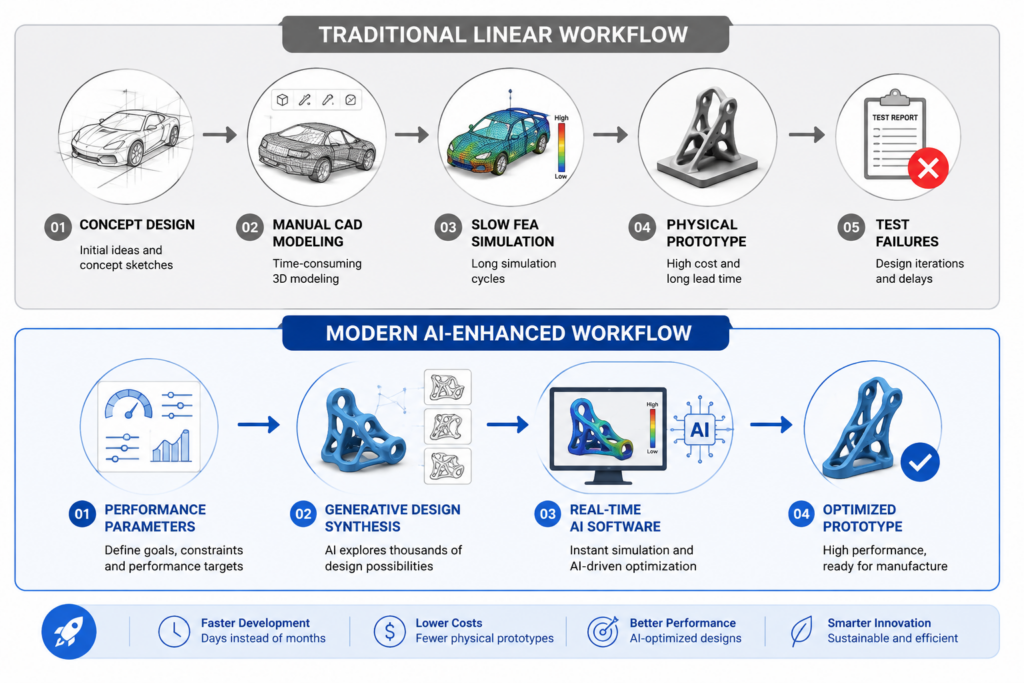
AI engineering design replaces slow manual drafting. It delivers instant, high-fidelity digital previews. Engineers formerly spent weeks drafting baseline CAD models.
Today, smart algorithms generate valid options in minutes. This shift changes the entire design process.
Accelerating Early Ideation Phase
Engineers use generative design to discover optimal structures fast. The software balances physical stress parameters. It monitors material usage and weight limits automatically.
Thus, teams test hundreds of ideas in hours. Modern generative design delivers lightweight parts. These parts retain full structural integrity under heavy loads.
Managing Complex Simulation Tasks
Simulations take days on traditional computing setups. AI-assisted engineering software can accelerate simulation workflows and provide faster feedback on structural performance. AI-assisted models can help identify potential stress concentrations earlier in the design process. Engineers adjust parameters without waiting for offline analysis.
Performance & ROI Metrics
| Key Performance Indicator (KPI) | Measured Impact | Source / Citation |
| End-to-End Engineering Delivery Acceleration | 1.9x Speed Improvement | HTEC Engineering ROI Framework |
| Requirements-to-Production Velocity | +60% Speed Gain | HTEC Engineering ROI Framework |
Why Is Engineering Automation Essential for Modern Technical Teams?
Engineering automation removes tedious manual data entry. It eliminates repetitive quality validation checks.
Engineering teams process huge sensor datasets daily. They analyze strict regulatory specifications constantly. Without automated tools, engineers waste precious time. They spend hours reviewing basic technical documentation manually.
Reducing Critical Human Errors
Manual calculations carry high financial risk. Engineering automation checks dimensional tolerance automatically. Algorithms scan drawings for misaligned parts quickly.
This precise validation occurs before physical manufacturing starts. It prevents expensive engineering errors late in development.
Unifying Disparate Data Systems
Modern AI in engineering links CAD data directly to ERP platforms. Updates in geometric files adjust raw material costs instantly.
Consequently, project managers track exact expenses accurately. They maintain full cost control throughout the iterative design cycle.
What Impact Does AI Engineering Software Have on Design and Production Cycles?
AI engineering software merges geometry creation with material selection. Engineers select desired performance metrics. They define specific thermal parameters first.
The platform generates optimized structures next. These structures are generated against defined performance, material, weight, and manufacturing constraints.
Comparative Workflow Overview
| Design Workflow Stage | Traditional Manual Workflow | Modern AI-Driven Workflow | Primary Operational Benefit |
| Concept Generation | Manual CAD Sketching | Generative Design Algorithms | Drastic Acceleration in Conceptualization |
| Structural Analysis | Offline FEA Simulations | Real-Time AI Engineering Software | Instant Structural Stress Feedback |
| Quality Validation | Manual Compliance Audits | Engineering Automation Scripts | Reduced manual validation effort |
| Material Selection | Static Catalog Searches | Smart AI in Engineering Datasets | Optimal Weight and Production Cost |
Expanding Structural Multi-Physics Analysis
Older software handles one physical force at a time. Modern AI engineering software analyzes multiple forces simultaneously. It evaluates heat, vibration, and pressure together. Engineers catch hidden design flaws early in the digital pipeline.
Improving Sustainable Manufacturing Outputs
Eco-friendly production requires minimal material waste. Generative design produces organic, highly efficient shapes. It uses minimal material volume overall.
Paired with 3D printing, AI engineering design reveals new potential. It enables ultra-light, eco-friendly components for industrial manufacturing.
Where Can AI Deliver the Greatest ROI in Engineering?
The adoption of AI in engineering yields a high financial return. Physical prototypes cost thousands of dollars per iteration.
Virtual simulation powered by AI engineering design cuts physical testing iterations. It saves time, labor, and operational capital.
Minimizing Physical Testing Waste
Simulations predict exact failure points early. They analyze stress before the hardware assembly begins.
Teams deploy AI in engineering to run stress tests virtually. This shift saves valuable material resources. It avoids costly physical test failures on factory floors.
Extending Asset Lifecycle Durability
Predictive algorithms calculate operational wear accurately. They analyze component wear over long operating cycles.
AI can recommend geometry changes intended to address identified stress concentrations. Thus, AI engineering design extends operational life for heavy industrial machinery.

How Will AI Engineering Design Shape Enterprise R&D Strategies?
Future R&D programs depend on continuous AI engineering design integrations. Systems learn continuously from past production outcomes.
They evaluate real-time operational data from active machinery. Every manufactured part feed real performance metrics back to central models.
Driving Autonomous Co-Pilot Workflows
Future AI engineering software acts as a design assistant. Engineers provide simple functional prompts to guide system output.
The AI suggests structural improvements instantly. It bases suggestions on global historical engineering data.
Enhancing Cross-Disciplinary Team Synergy
Complex projects require multidisciplinary coordination. Electrical, mechanical, and software teams must collaborate closely.
Platform tools powered by AI in engineering harmonize multi-domain requirements. Teams resolve physical spatial conflicts automatically within unified design platforms.
Conclusion
Adopting engineering automation requires specialized technical expertise. Panaceatek delivers modern digital solutions. These solutions revolutionize modern business operations across industries. Panaceatek offers deep proficiency in software development and artificial intelligence.
AI is not replacing engineering expertise. It is changing where engineers spend their time. Instead of manually creating every design variation, running repetitive checks, and waiting for sequential simulations, teams can use AI to explore alternatives, automate repetitive work, and make faster data-driven decisions.