
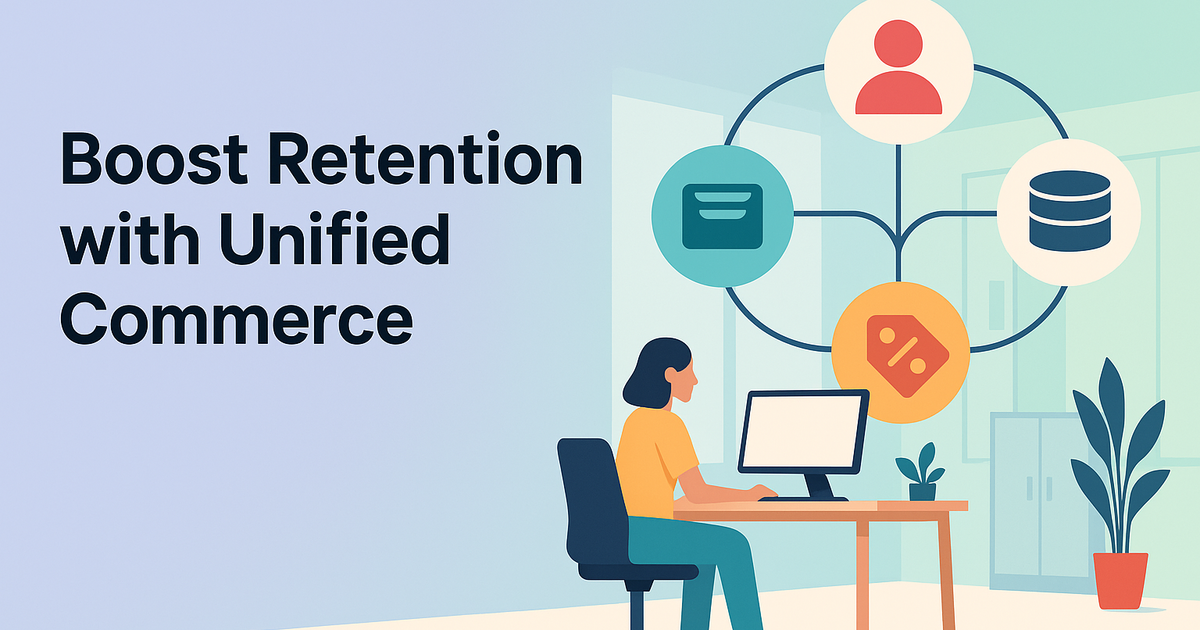
Shoppers bounce from mobile app to marketplace to physical store, and every hand-off that isn’t smooth costs you money, loyalty, and sleep. A fully unified path, where baskets, promotions, and service histories follow the customer, turns that friction into higher lifetime value. In fact, retailers with strong omnichannel commerce engagement retain 89% of their customers compared with 33% for those with weak engagement (Aberdeen Group, 2020). Over the next few minutes, you’ll see why omnichannel retail is replacing patchwork multichannel retail setups, the building blocks required, common pitfalls to dodge, and a proven roadmap to deliver a seamless omnichannel experience without the scope-creep nightmares you’ve lived through before.
Why Traditional Multichannel Retail Is Falling Short
Managing a separate eCommerce site, point-of-sale system, and marketplace feed used to be enough. Not anymore. Customers expect one brand conversation, not three disconnected ones.
- Siloed data: Different inventories create “out-of-stock” moments that send shoppers to competitors.
- Fragmented marketing: Email teams can’t see in-store returns, so offers miss the mark.
- Clunky hand-offs: Call-center agents lack order visibility from Instagram checkout, forcing customers to repeat themselves.
These gaps aren’t just annoying; they’re expensive. A Google study found 89% of consumers start purchases on one device and finish on another (Google, 2021). If your systems can’t keep up, you bleed conversions at every switch.
What True Omnichannel Commerce Looks Like
A mature omnichannel customer journey weaves every piece of the customer journey into one fabric: search, browse, promo, purchase, fulfillment, service, and re-engagement. The goal is a seamless customer experience so consistent that channel boundaries disappear.
Integrated Digital Channels vs. Siloed Systems
Integrated digital channels share four fundamentals:
- One customer profile feeds all touchpoints
- Real-time inventory and pricing synchronization
- Centralized promotion and loyalty logic
- Unified analytics for end-to-end attribution tracking
With these in place, the omnichannel customer journey morphs from a maze into a straight line with dead ends, no data loss.
Ignite Your Business’s Digital Future
Panacea Infotech empowers your business with cutting-edge web, mobile, and AI solutions, future-proofing your growth and keeping you ahead of the competition
Building Blocks for a Seamless Omnichannel Experience
Successful retail digital transformation normally follows a predictable architecture. Below are the non-negotiables many vendors gloss over:
- Commerce engine: with robust API coverage to plug into legacy ERP, CMS, and warehouse tools.
- Middleware or ESB layer: that normalizes data across the multi-vendor ecosystem, reducing brittle point-to-point connections.
- A customer data platform (CDP): to merge in-store POS, eCommerce, and social interactions into a single profile.
- Real-time inventory services: delivering accurate stock levels to every touchpoint.
- Attribution-ready analytics stack: so marketing dollars can be tied to sales, not vanity metrics.
Note: If even one block is missing, teams get dragged back into swivel-chair workarounds that erode trust and margin.
Process Transparency: How We Integrate, Enhance, and Execute
Tired of vendors that “go dark” after kickoff? Below is the exact scope management framework our team has refined over 19+ years of simplifying technology.
1. Strategic Discovery
Stakeholders align on business KPIs, channel pain points, and customer personas. You get a roadmap, timeline, owners, and deliverables before a single line of code.
2. Data & Platform Audit
Panaceatek run non-intrusive diagnostics across POS, CMS, ERP, and marketing systems to surface hidden dependencies that cause later rework.
3. Architecture Design & Pilot
A low-risk pilot (often BOPIS or endless-aisle) proves value in 10–12 weeks. You see a working slice of the seamless omnichannel experience while we refine integrations.
4. Phased Rollout
Features scale across regions and brands in sprints, not “big bang” releases, reducing downtime and surprise invoices.
5. Continuous Optimization & ROI Accountability
Joint dashboards track order conversion, average order value, and retention against baseline. When numbers dip, we adjust; no finger-pointing.
Pro Tip: Ask any vendor how they handle mid-project scope changes. If the answer isn’t backed by a documented change-control process, run.
Common Pitfalls and How to Avoid Them
- Over-customization: of off-the-shelf platforms makes future upgrades impossible.
- Ignoring store-associate workflows: buy-online-return-in-store dies without clerk adoption.
- Deferred data cleansing: “dirty” product and customer data pollute every new channel.
- Lack of executive sponsorship: projects stall when one department holds the budget hostage.
Each failure mode is preventable with clear ownership, phased delivery, and measurable success metrics baked into contracts.
Transform Ideas into Digital Reality
Whether it’s custom software, mobile apps, or next-gen eCommerce solutions, Panacea Infotech empowers businesses with technology that drives growth.
ROI Accountability and Attribution Tracking
Omnichannel commerce investments can’t live on gut feel. When decision-makers can trace revenue back to campaigns and channels, budgets shift from cost centers to growth levers.
- Unified dashboards: tie loyalty identifiers to both online and store transactions.
- Machine-learning models: predict churn, enabling proactive offers instead of blanket discounts.
- Regular executive reviews: compare projected ROI against live KPIs; no hidden surprises.
Bottom line: Reliable attribution unlocks smarter spend, not bigger spend.
Educational Snapshot: Curbside Pickup as a Gateway to Full Omnichannel
Many retailers dip a toe in by offering curbside pickup. Why it works:
- Customers instantly see value: speed and convenience.
- Operationally: it forces real-time inventory accuracy and order routing discipline.
- Once data flows: between eCommerce and store, expansion to endless-aisle or ship-from-store is straightforward.
No sales pitch here; just a proof point that small, highly visible wins can fund broader transformation.
Getting Started: Clear Next Steps
1. Map Current Journeys
Document where customers drop off or call support; these are your high-ROI targets.
2. Prioritize Data Unification
Agree on the “one source of truth” for inventory and customer profiles before chasing shiny features.
3. Pilot, Measure, Scale
Limit initial scope to one region or product line, then expand only when KPIs validate success.
Ready for a Transparent Partner?
You’ve seen how a disciplined approach turns omnichannel commerce from buzzword to bottom-line reality. If you’re looking for a trusted digital partner, not just another vendor, Panaceatek combines a customer-centric approach, proven track record, and 19+ years of integrating, enhancing, and executing complex retail solutions. Let’s discuss your specific challenges, share timelines upfront, and put you in control of every asset we touch. Schedule a 30-minute consultation at your convenience; your business, your decisions, our expertise.
A seamless omnichannel experience isn’t a dream; it’s the next stage of retail digital transformation. Let’s make it happen together, minus the headaches you’ve endured before.