

Software engineering is undergoing a major paradigm shift. Enterprises face constant pressure to ship software faster. However, traditional software cycles struggle to keep pace with modern market demands.
Legacy hand-coding creates severe obstacles, forcing engineering teams to balance strict architectural governance against the demand for rapid delivery. High-application complexity often turns simple feature rollouts into long, resource-intensive engineering cycles that drain developer productivity.
Integrating OutSystems with AI-driven automation reduces this friction. Rather than relying on manual boilerplate coding, teams leverage AI-assisted visual modeling to manage data architecture, automate compliance checks, and safely accelerate full-stack application builds. This targeted pairing allows enterprise developers to manage complex system logic effortlessly while keeping governance tight and delivery schedules short.
Combining OutSystems AI development with smart automation empowers teams to develop complex applications more efficiently.
At Panaceatek, we guide companies through this digital shift. We help organizations build customized systems that deliver measurable growth.
What Is Driving the Shift Toward AI-assisted Low-code Platform?
Enterprises need to deliver custom software quickly. Traditional development can require significant time and resources, particularly complex enterprise applications. Visual low-code development solves speed issues by aligning basic logic.
Now, adding artificial intelligence can further improve development efficiency. AI-assisted low-code tools reduce repetitive development work. Developers no longer spend hours on routine setups or basic bug fixes. Intelligent platforms generate complex data models from simple plain text descriptions.
This evolution changes the developer’s role in day-to-day. Engineers shift focus from repetitive setup work toward architecture, solution design and business logic. As a result, software teams deliver complex projects in weeks instead of months.
Industry Insights
- 40% Faster Delivery: AI-driven platforms like OutSystems reduce full development lifecycles significantly.
- 75% Adoption Target: Industry analysts predict most new enterprise software will rely on low-code solutions.
- 80% Non-IT Involvement: Business users actively participate in app delivery using smart visual tools.
Source: Outsystems , ranosys

Enterprise Low-Code & AI Adoption Trends
| Metric / Indicator | Industry Benchmark | Business Impact |
| Development Cycle Reduction | Up to 40% faster completion | Accelerates market release dates. |
| Enterprise Adoption Rate | Significant number of new apps use low code | Reduces reliance on legacy code. |
| Non-IT Developer Growth | Mainly used outside of core technical departments | Bridges technical talent gaps. |
| System Security & Quality | Real-time automated checks | Minimizes post-launch security bugs. |
How Does OutSystems Integrate AI into Application Development?
OutSystems builds artificial intelligence directly into its core engine. Through its powerful Mentor system, OutSystems AI development guides engineers continuously. ineers continuously.
- Smart Code Generation: OutSystems converts plain language requirements into complete app modules instantly.
- Automated Architecture Checks: OutSystems checks logic against enterprise standards during development.
- Real-Time Bug Detection: OutSystems can help identify potential performance and quality issues during development.
- Guided Integration Setup: OutSystems links enterprise databases and external APIs with minimal setup effort.
Through OutSystems AI development, engineering teams prevent common architectural mistakes early. The platform suggests optimized logic paths automatically. This continuous guidance maintains clean standards across large software projects.
Why Are Custom Enterprise Applications Built Faster Using OutSystems?
Custom enterprise applications require strict security, smooth integration, and steady scalability. Traditional development often stalls when building these deep infrastructure foundations.
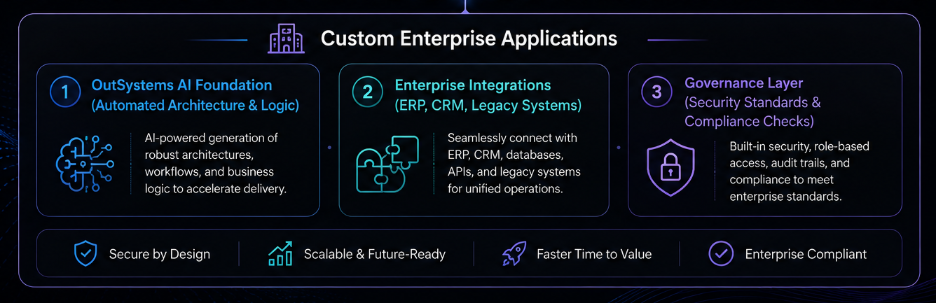
Combining visual design with OutSystems AI development eliminates deployment delays. Pre-built templates, automated pipelines, and intelligent tools manage overall setup.
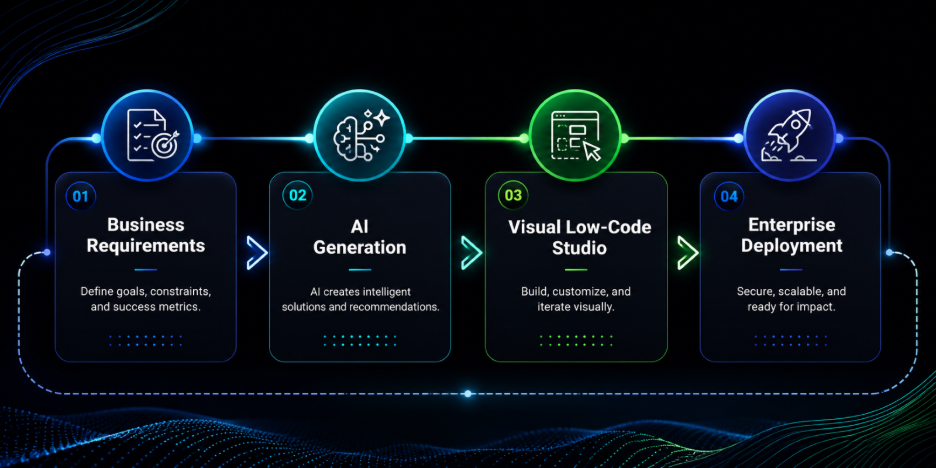
Developers state core app requirements clearly
Development teams initiate projects by outlining functional needs in plain language. Instead of spending days writing manual setup documentation, teams define target workflows, user roles, and data relationships directly. This clear entry point allows AI-assisted low-code platforms like OutSystems to translate business goals into actionable system blueprints immediately.
Smart algorithms generate essential structural logic
Intelligent generation engines process user requirements to build core application structures instantly. Through modern OutSystems AI development, algorithms assemble data models, create backend APIs, and link user interfaces automatically. This automated scaffolding eliminates repetitive setup work, so teams start building advanced features right away.
Visual tools let engineers refine custom business rules smoothly
Visual drag-and-drop interfaces allow engineers to adjust complex logic without wrestling with raw code syntax. Teams use intuitive low-code designers to build tailored features, integrate legacy databases, and customize user journeys. This interactive visual workspace ensures developers maintain fine-grained control over unique business logic.
Governed deployment pipelines support faster and more controlled application deployment
Automated continuous integration and deployment pipelines validate performance before pushing updates to production environments. OutSystems continuously scans visual logic to enforce corporate security policies, track cross-app dependencies, and block bugs. As a result, enterprises release application updates rapidly without compromising stability or security governance.
This combined workflow reduces operational delays across every launch phase. Enterprises gain scale without sacrificing platform security or app stability.

How Does an AI-assisted low-code maintain robust security and governance standards?
A common worry about fast software development is losing control over governance. AI-assisted low-code platforms address this concern by automating quality assurance directly into the workflow.
OutSystems continuously scans visual logic for potential vulnerabilities. The engine flags security issues long before code moves to production.
- Automated Compliance: OutSystems enforces corporate security rules across every single application module.
- Dependency Tracking: OutSystems analyzes system changes to prevent unexpected breakages across app updates.
- Full Audit Control: OutSystems maintains detailed version logs for clear compliance reporting.
This proactive governance allows enterprises to progress safely and speedily. Companies build customized tools while maintaining strict enterprise compliance.
OutSystems AI vs. Traditional Low-Code
| Development Stage | Traditional Low-Code Development | OutSystems AI-Assisted Low-Code |
| Initial App Setup | Manual drag-and-drop structural design | Generates data models from text prompts. |
| Logic Validation | Manual peer reviews and testing | AI-driven checks inspect rules in real time. |
| System Refactoring | Time-consuming manual dependency fixes | Automated refactoring updates linked logic. |
| Security Auditing | Periodic manual security assessments | Continuous automated scanning during builds. |
How Does Panaceatek Accelerate Digital Business Transformation?
Adopting modern low-code development requires the right strategy, architecture, and team experience. Panaceatek brings years of proven expertise in modern digital solutions.
Our skills span software development, artificial intelligence, content management, e-commerce, and engineering design. We also specialize in supply chain logistics, manufacturing systems, and IT staff augmentation.
We leverage OutSystems AI development to build custom enterprise applications customized to your operational needs. Whether modernizing legacy portals, creating mobile tools, or automating complex workflows, Panaceatek delivers dependable results. We help your business scale efficiently while keeping overall technical debt low.
Conclusion
Combining artificial intelligence with visual engineering is not a passing phase. It represents the future foundation of enterprise software delivery. OutSystems bridges the gap between unmatched AI speed and strict enterprise security. Businesses no longer need to choose between rapid delivery and architectural stability. By using AI-assisted low-code, organizations build scalable solutions that grow with market demands.