

The Shopify Dream vs. the Reality of Scale Shopify has made it easy to start an online store. With flexible themes, built-in payments, and a vast app ecosystem, businesses can go live in a matter of days instead of months. However, many Shopify stores struggle to survive after their initial growth stage.
The reasons for this are not always clear at launch. What starts as a smooth setup can lead to performance issues, operational challenges, and scaling limits as traffic and orders increase. In 2026, customer expectations for speed, reliability, and experience will be high.
These weaknesses can quickly hinder growth. This blog explains why new Shopify stores fail, the common mistakes merchants make, and how careful planning can avoid costly rework later.

Launching Without a Scalable Foundation
One of the most common mistakes new merchants make is building their Shopify store only for launch day needs. Default themes, heavy reliance on apps, and minimal backend planning may work at first, but they rarely support growth.
As traffic increases, stores start to face slower load times, unstable checkout processes, and challenges with integrating inventory, fulfillment, or pricing systems. Expanding into new regions or adding more complexity often requires redesigning large parts of the store.
Successful digital platforms in various industries demonstrate that systems built for long-term growth rely on early design choices. This is especially true when they need to manage increasing transaction volumes and complex workflows.
Rushed Store Setup and Structural Gaps
Many Shopify store issues come from rushed launches. Merchants often prioritize design and neglect structure, including navigation logic, product categorization, and consistent checkout flow.
Common problems include:
- Confusing menus and product discovery paths
- Inconsistent product data across collections
- Checkout experiences that feel disconnected or cluttered
- Limited consideration for mobile-first users
These issues don’t always lead to immediate failure, but they slowly lower conversion rates and raise bounce rates. Over time, stores need expensive redesigns to fix problems that better planning could have prevented.
Treating Performance as a Secondary Concern
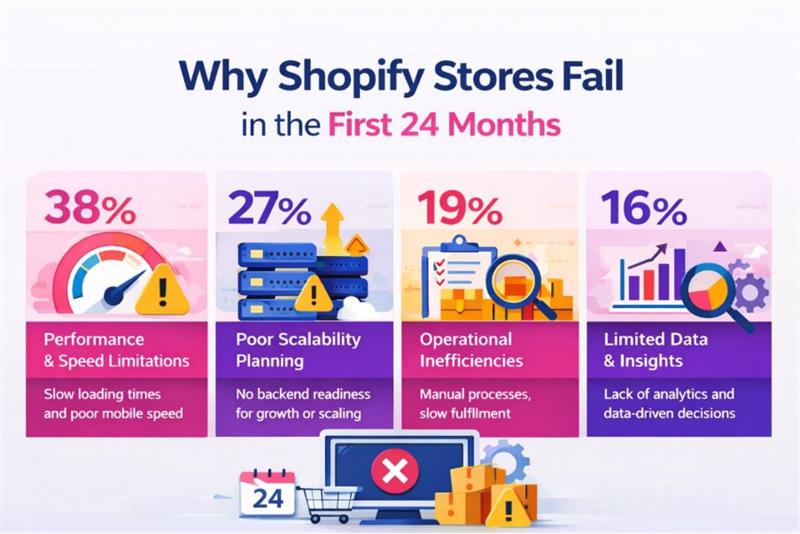
Speed directly impacts customer trust and conversion. However, many Shopify stores only focus on performance after they see a drop in engagement or issues with paid traffic.
Performance problems often come from:
- Excessive third-party apps
- Heavy scripts and unoptimized assets
- Poor cloud configuration choices
- Lack of performance monitoring
Each delay adds to user frustration, especially on mobile devices. These problems are typical when cloud deployments aren’t set up for efficiency and security right away. This can lead to long-term performance issues as traffic increases.
Underestimating Operational Complexity
Shopify makes it easy to manage storefronts, but operations grow separately from the platform. As order volumes rise, merchants frequently find that manual workflows fail to keep up.
Typical operational challenges include:
- Inventory mismatches across channels
- Delayed order fulfillment
- Limited visibility into order status
- Increased customer support volume
Without automation, these issues raise operational costs and damage customer experience. Businesses that operate at scale, especially in logistics-heavy environments, have found that automation is crucial for keeping accuracy and speed as complexity increases.
Operating Without Meaningful Analytics
Many Shopify merchants depend on basic metrics without grasping how users engage with their store. Without clear data driven decision-making becomes reactive rather than strategic. A lack of analytics makes it hard to: –
- Identify checkout issues
- Understand customer behavior
- Optimize pricing and promotions
- Measure marketing effectiveness
Industries that handle financial or operational risk depend on analytics to guide decisions. Using the same data-focused approach can help Shopify businesses shift from trial and error to steady growth.
Overlooking Security and Compliance as the Store Grows
As Shopify stores manage more transactions and customer data, security risks grow. Still, many merchants see security and compliance as secondary concerns until problems occur.
Common risks include: –
- Vulnerable third-party apps
- Weak access controls
- Poor data governance
- Limited awareness of privacy obligations
Other industries have strict regulatory requirements.
Relying Too Long on DIY Development
Shopify’s ease of use encourages a do-it-yourself approach. However, as stores grow, this can become a limitation. Custom workflows, performance optimization, and complex integrations need professional expertise.
- Experienced development teams help businesses:
- Optimize themes and checkout processes
- Build headless commerce setups
- Integrate ERP, CRM, and fulfillment systems
Plan for long-term growth Well-organized engineering practices lower risk and make sure systems develop with business needs.
Conclusion: Avoiding Shopify Failure in 2026
Avoiding Shopify Failure in 2026 Most Shopify failures come from decisions made early, often without thinking about scale, performance, or how complex operations can get. In 2026, successful Shopify stores will focus on long-term growth rather than just quick launches.
Sustainable success depends on:
- Strong architectural foundations
- Performance-focused development
- Automated operations
- Data-driven decision-making
- Professional development support
When these elements align, Shopify becomes a stable and scalable growth platform.
How PanaceaTek Supports Scalable Shopify Growth
PanaceaTek helps businesses build Shopify ecosystems designed for performance, scalability, and long-term reliability. With expertise in custom Shopify development, system integration, and optimization, PanaceaTek supports merchants as they move beyond launch-stage limitations and prepare for sustainable growth.
FAQs
1. Why do most new Shopify stores fail?
Most failures occur due to scalability issues, performance problems, and operational inefficiencies rather than product quality.
2. What mistakes should Shopify merchants avoid in 2026?
Ignoring performance, delaying automation, weak analytics, and underestimating operational complexity are common mistakes.
3. When should businesses invest in Shopify development services?
Once customization, integrations, and performance needs exceed standard themes, professional development becomes essential.
4. How doesPanaceaTek help Shopify stores scale?
PanaceaTek delivers scalable development, performance optimization, and enterprise-grade integrations tailored to growing businesses.